Property Investment Guide
Silver Palace's city economy: buying numbered premises with Stocks, revenue by the minute, Land Ownership and Milestones, and the five Stocks achievements.
Every other system in Silver Palace pays you for working. Property Investment pays you for owning. You buy into premises around Silvernia, those holdings earn revenue while you are elsewhere, and you collect it from a screen the game calls City Property. It is the closest thing the city has to a second income, and it is the one place where the shopfronts you walk past stop being scenery and start being addresses with numbers.
This guide covers the loop from the in-game tutorial text, the City Property screen as it appears in gameplay footage, and the achievement data: what the system is, what Stocks are and who prints them, how observing and buying a property works, what a district's Land Ownership and Milestone track show you, and the five Stocks milestones that pay 90 Reactor Crystals between them.
What Property Investment is
The system is described in two sentences by the game itself. Investing in and managing businesses in property continuously generates revenue, and earnings accumulate whether you are watching or not: unclaimed revenue banks up rather than expiring. The tutorial frames the claim as a daily one, while the live screen runs a much shorter cycle, which is covered below.
The second half of the tutorial names the screen you work from. An Information List shows the shop upgrades, shop businesses and property purchases currently available, which makes it the one place to check what your Stocks can actually do today.
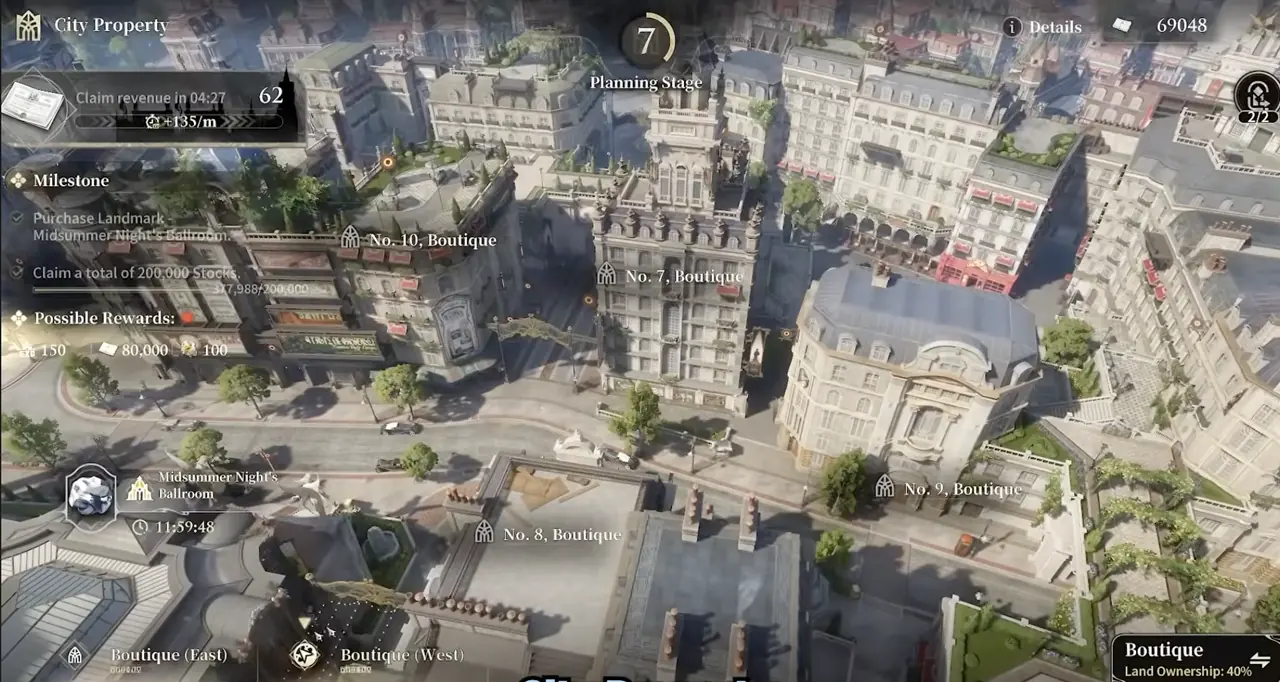
The City Property screen for the Boutique district: numbered premises, a Milestone track, an accrual rate over a claim countdown, and the district's Land Ownership share. Source: official Silver Palace gameplay footage.
What the City Property screen shows
That one screen answers more about the system than the tutorial text does.
Revenue is a rate, not a lump. The panel top left prints an accrual of +135 Stocks a minute with a claim countdown of a few minutes over it and the banked figure beside it. So the money is ticking while you play, and collecting is a short errand you do in passing rather than a daily chore. That is roughly 194,400 Stocks a day if you never miss a claim.
A district is a set of numbered addresses. The Boutique district shows premises labelled No. 7, No. 8, No. 9 and No. 10, with two sub-areas named Boutique East and Boutique West at its edge. The card in the corner gives the district's Land Ownership as a percentage, 40 percent in this capture, so ownership is tracked per district rather than only per building, and the arrows on that card switch you to the next district.
A Milestone track sets the goals. Two objectives are listed: purchase the Landmark, and claim a total of 200,000 Stocks. Midsummer Night's Ballroom is the named Landmark, and its own card carries a countdown just under twelve hours, so the largest purchases resolve on a timer. The track pays three reward lines, the largest of them 80,000 in Stocks notes.
Planning Stage sits at the top of the screen as a numbered ring, reading 7 in this capture, which is a progression counter for the district rather than for any single property.
Stocks, and who prints them
Property Investment spends one currency, and the game only explains it in a single item description:
A type of negotiable Stocks. Their use is spearheaded by the United Mining Industry (UMI). Given the recent abundance of capital, Stocks have achieved even higher fluidity than traditional currency. It is simply astounding that this flimsy piece of printed paper has a value on par with that of Silverium.
The line under it is sharper: "The paper itself is meaningless. Its true power lies in UMI's willingness to provide its holder with all relevant rights and commitments."
Read that next to what the site already publishes about UMI and the point lands. The corporation that controls the Reactor trade also issues the paper the city invests in, and the item art is exactly what that implies: a bundle of share certificates with a printed denomination, a red overprint, an embossed seal and a countersignature. The same bundle is the currency icon in the City Property header. The currency of the city's property market is a promise from a mining company, and it is quoted against Silverium itself.
Observe, evaluate, invest
Buying into a property runs in three steps, and the first one is not a menu.
Observe. You look at a building. Investable properties are observed in the world to bring up their detailed information, and the tutorial's own frame puts the marker on a shopfront in a busy commercial street, drawn as the same eye glyph the game hangs over anything else worth a closer look.
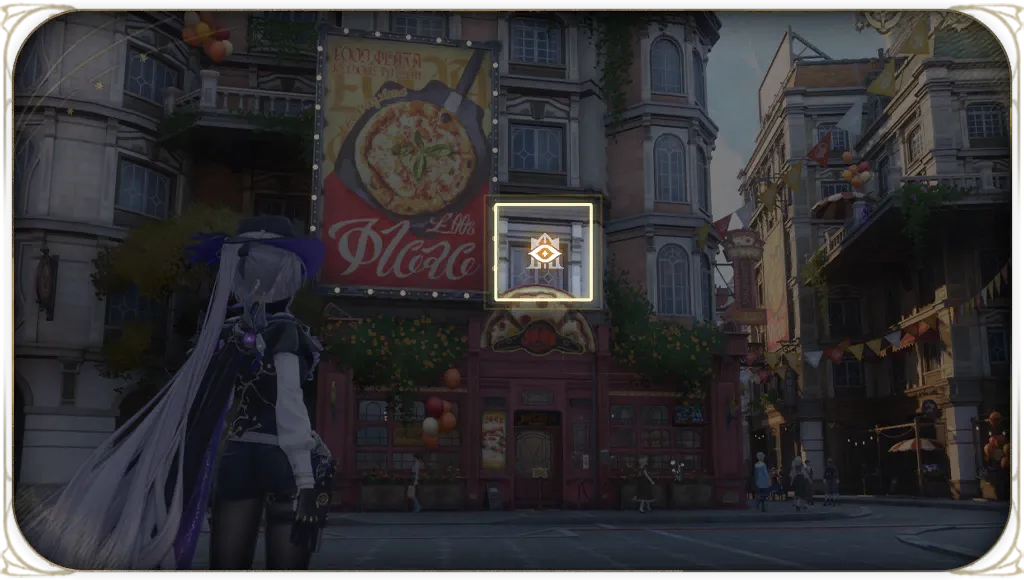
Investable premises are found on foot and observed in the world. The tutorial's chosen example is a pizzeria under a painted billboard. Source: official Silver Palace in-game tutorial.
Evaluate. Properties you can still buy and investments you have already made are shown as one list, so you can weigh your holdings and expand the portfolio from a single screen without walking the district again.
Invest. Having observed a property you are interested in, you may invest as long as you hold the Stocks to pay for it. There is no other gate stated anywhere in the tutorial text: the price is the requirement.
Upgrading a business and its Commercial Value
Once a shop is open for business it becomes an upgrade target. Spending Stocks on it fully improves its Commercial Value and makes it more profitable, which is the game's own phrasing and the only definition of Commercial Value it gives you.
That is the real decision the system asks of you, because both halves of it want the same currency. Every Stock you spend deepening a business you already hold is a Stock you are not spending on the next numbered address, and the district's Land Ownership percentage only moves for one of those two.
The five Stocks milestones
Property Investment has its own achievement group, filed under Flashbacks & Subplots alongside Hilbert's Hotel and Bounty Writ. All five milestones ask the same thing in escalating amounts, and they pay Reactor Crystals:
| Achievement | Goal | Medal | Reward |
|---|---|---|---|
| Prelude to Success | Own a total of 1,000,000 Stocks. | Bronze | 10 Reactor Crystals |
| Property Guru | Own a total of 5,000,000 Stocks. | Bronze | 10 Reactor Crystals |
| Business Tycoon | Own a total of 10,000,000 Stocks. | Silver | 20 Reactor Crystals |
| Investment Magnate | Own a total of 100,000,000 Stocks. | Silver | 20 Reactor Crystals |
| Gazillionaire | Own a total of 500,000,000 Stocks. | Gold | 30 Reactor Crystals |
90 Reactor Crystals in total, which is a quarter of one 360-crystal Revelation, so the group is a completion target rather than an income plan. The site's gem accounting has the full pull maths.
What the numbers say about the system's intended lifespan is more interesting than the payout. The first milestone asks for a million Stocks and the last asks for five hundred million, a five-hundredfold climb inside one group, and the steps between them multiply by five, then two, then ten, then five again. Hold that against the 135 a minute on the City Property screen: one district earning at that rate takes about seven years to total 500,000,000. The gold tier is not written for one district at starting rates, which is the clearest signal in the data that holdings are meant to compound across the whole city.
The Milestone track makes the same point from the other end. Its goal is to claim 200,000 Stocks, which the top achievement then multiplies by 2,500, and it is the kind of target you clear in a session.
Where the city's shops fit
The game names twelve premises in its item data, six of them food shops and the rest selling clothing, perfume, books, toys and sundries: Gelato & Chill, Wheaty Baker & Deli, Milk Punch, Perfumes & Vanity, Solferino Branch, Solferino Flagship Store, Burgerstack Masters, Honey and Milk, Chipmunk Grocery, McBarley, Wisdom Books and Hearts and Arrows. Eight further premises are numbered in the same block with nothing stocked against them, which reads as room reserved for later.
The site covers what those shops sell in the food, drink and shops piece. What no released text does is join that list to the property market: nothing says the twelve named shops are the investable premises. What City Property does show is that the premises it sells you are numbered addresses inside a named retail district, and that the tutorial's chosen example of an investable building is a shopfront. The city you buy into and the city you shop in are drawn from the same street.
Frequently Asked Questions
What is Property Investment in Silver Palace?
Property Investment is the city economy system, and the screen it runs on is called City Property. You buy into premises around Silvernia with Stocks and those holdings generate revenue for you. An Information List collects the shop upgrades, shop businesses and property purchases available at any moment, and a Milestone track sets goals across the district you are working in.
What are Stocks used for?
Stocks are the only currency Property Investment spends. They buy into a property, and they pay for upgrading a business you already own. No other system in the game spends them, and Property Investment spends nothing else: Ounce, Reactor Crystals and Glory Coin all belong elsewhere.
Who issues Stocks in Silvernia?
The United Mining Industry. The in-game item description says their use is "spearheaded by the United Mining Industry (UMI)" and that Stocks have achieved higher fluidity than traditional currency, with a flimsy printed page valued on par with Silverium. The currency icon in the City Property header is that same bundle of UMI share certificates.
How often can you claim property revenue?
The tutorial text says earnings are counted by the day and claimed once each day, with unclaimed revenue accumulating rather than expiring. The City Property screen in gameplay footage is finer grained than that: it prints a claim countdown of a few minutes over an accrual rate of 135 Stocks a minute. Either way, unclaimed revenue banks up while you are away.
What does Commercial Value do?
Commercial Value is the profitability rating attached to a business. A shop that is already open for business can be upgraded by spending Stocks, which fully improves its Commercial Value and makes it more profitable. That is the only definition the game gives it, and it is the reason upgrading an existing holding competes with buying a new one.
What is Land Ownership in City Property?
A percentage held per district rather than per building. The Boutique district card reads Land Ownership 40 percent, alongside numbered premises running No. 7 to No. 10 and two sub-areas labelled Boutique East and Boutique West. So a district is a set of numbered addresses you own a share of, and the card is how you see that share.
What is a Landmark in City Property?
The largest class of purchase, and a Milestone objective in its own right. The Boutique district names Midsummer Night’s Ballroom as a Landmark to purchase, and its card carries a countdown just under twelve hours, so Landmarks are timed acquisitions rather than instant ones.
What do the Property Investment achievements reward?
Five milestones paying 90 Reactor Crystals in total: 10 each for holding 1,000,000 and 5,000,000 Stocks, 20 each for 10,000,000 and 100,000,000, and 30 for the gold-medal Gazillionaire at 500,000,000. They sit in the Property Investment group under the Flashbacks & Subplots achievement category.
Is Property Investment the same thing as real estate investment?
It is the same system under a different name. The current build labels the screen City Property and every tutorial page Property Investment, while the achievement group carries an icon file named for real-estate investment. Community write-ups use all three wordings, so treat real estate as the descriptive term and Property Investment as the in-game one.